Introduction
Have you ever noticed that your first night back at work after the weekend feels much harder than the rest of your workweek?
You may have slept what seemed like enough over the weekend, yet as your first overnight shift begins, your eyelids feel heavy, your energy disappears, and staying focused becomes a challenge.
If this sounds familiar, you’re not alone.
Millions of permanent night-shift workers—including healthcare professionals, manufacturing employees, first responders, warehouse associates, and security personnel—experience the exact same thing every week.
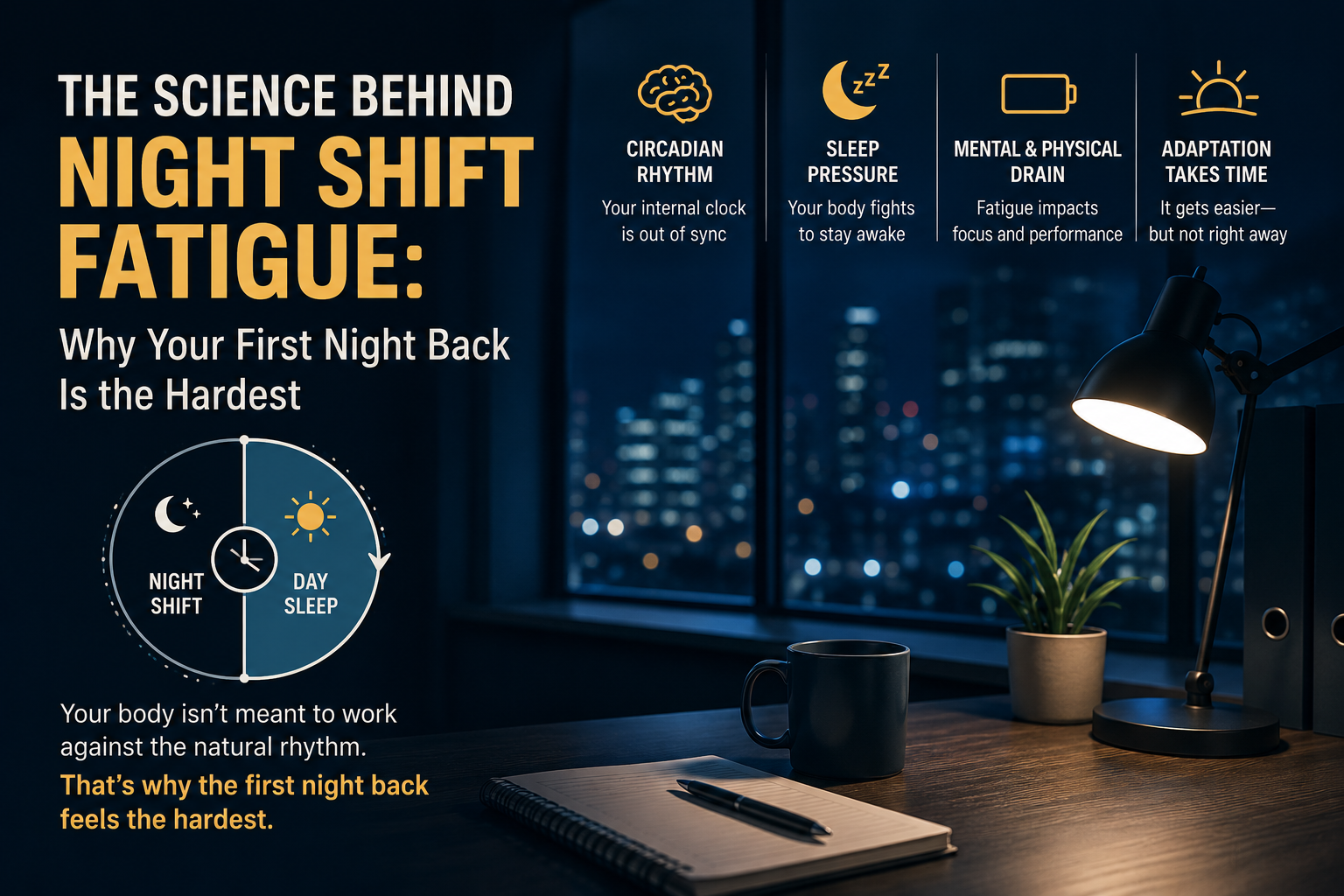
The surprising part is that it isn’t simply because you’re tired or didn’t sleep enough. The real reason lies deep inside your brain and body. It’s driven by your circadian rhythm, your body’s internal biological clock.
Let’s explore the science behind why your first night back is often the hardest, and what you can do to make the transition easier.
Your Body Runs on an Internal Clock
Inside your brain is a tiny group of nerve cells called the suprachiasmatic nucleus (SCN), often referred to as your master biological clock.
This internal clock regulates nearly every aspect of your daily rhythm, including:
- When you feel sleepy
- When you feel alert
- Hormones such as melatonin and cortisol
- Body temperature
- Digestion
- Blood pressure
- Mental performance
Under normal circumstances, this clock follows a roughly 24-hour cycle, helping you stay awake during the day and sleep at night.
For permanent night-shift workers, however, life requires your body to do the exact opposite.
Your Body Slowly Adapts During the Workweek
Imagine you work overnight from 10:00 PM to 6:30 AM.
During the workweek, your body gradually begins adapting to your schedule.
Instead of sleeping at night, you sleep during the day.
Although your circadian rhythm never completely reverses, your body slowly starts to adjust by:
- Delaying melatonin release
- Increasing nighttime alertness
- Shifting your body temperature cycle
- Developing a consistent daytime sleep routine
After several consecutive night shifts, many workers notice they feel more alert at work and sleep better during the day.
Your body is learning a new rhythm.
Then the Weekend Changes Everything
When the weekend arrives, many night-shift workers want to return to a more traditional lifestyle.
They begin:
- Sleeping at night
- Staying awake during the day
- Eating meals during normal daytime hours
- Spending more time outside in daylight
- Enjoying time with family and friends
From a social perspective, this makes perfect sense.
But biologically, your brain receives a completely different message.
Your internal clock begins shifting back toward a daytime schedule—but only for one or two days.
By the time you return to work, your body hasn’t fully adjusted to either schedule.
It’s caught somewhere in between.
Sleep scientists call this phenomenon social jet lag.
What Is Social Jet Lag?
Most people associate jet lag with traveling across multiple time zones.
Social jet lag is remarkably similar—but without ever getting on an airplane.
Instead of flying from one country to another, you’re repeatedly switching between:
- A night-shift schedule during the workweek
- A daytime schedule on your days off
Every time you return to work, your body experiences something very similar to crossing several time zones overnight.
Your biological clock becomes confused because it’s constantly being asked to move back and forth between two completely different schedules.
Why Your First Night Back Is the Hardest
By the time your first night back at work arrives, several physiological processes are working against you.
1. Your Brain Thinks It’s Bedtime
As evening approaches, your brain naturally begins releasing melatonin, the hormone responsible for promoting sleep.
Even though you’re getting ready for work, your brain is preparing you for bed.
2. Your Body Temperature Naturally Drops
Body temperature naturally decreases during the evening.
Lower body temperature is associated with:
- Reduced alertness
- Slower reaction times
- Increased sleepiness
This makes it much harder to stay mentally sharp during your first overnight shift.
3. Your Circadian Rhythm Hasn’t Fully Adjusted
One or two days simply aren’t enough for your internal clock to completely shift.
Instead, your body is caught between two conflicting signals:
“I should be awake.”
and
“I should be asleep.”
This internal conflict leads to fatigue, lower energy, and reduced performance.
4. Your Brain Has to Work Harder
Because your biological rhythm is temporarily out of sync, your brain must work harder to stay focused.
You may experience:
- Heavy eyelids
- Difficulty concentrating
- Slower reaction times
- Mental fog
- Reduced productivity
- Increased mistakes
- Feeling sleepy even after getting what seemed like enough sleep
Many night-shift workers assume they simply didn’t sleep enough.
In reality, their brain is fighting against its own biological clock.
Why the Second Night Often Feels Easier
Interestingly, many permanent night-shift workers notice that their second night back at work feels much easier than the first.
Why?
After completing your first night shift and sleeping during the day afterward, your body begins shifting back toward its overnight routine.
Although the adjustment isn’t complete, your circadian rhythm becomes more aligned with your work schedule.
As a result, your body starts recognizing nighttime as your active period again.
This is why many workers experience:
- Better alertness
- Improved concentration
- Faster reaction times
- Higher productivity
- More stable energy levels
By the second night, your body has already begun adapting back to overnight work.
How to Reduce First-Night Fatigue
Although you can’t completely eliminate circadian disruption, several science-backed strategies can make the transition much easier.
Keep Your Weekend Schedule Closer to Your Work Schedule
Instead of completely switching to daytime living every weekend, try making only a partial adjustment.
Going to bed slightly later and waking slightly later helps reduce the amount your biological clock has to shift.
Take a Strategic Nap
A 90-minute or 2–3-hour nap before your first night shift can significantly improve alertness.
This allows your brain to complete a full sleep cycle before work.
Use Bright Light During Your Shift
Bright light is one of the strongest signals controlling your circadian rhythm.
Exposure to bright light during the first half of your night shift helps your brain stay alert.
Optimize Your Sleep Environment
When sleeping during the day:
- Keep your bedroom cool.
- Use blackout curtains.
- Reduce noise whenever possible.
- Turn off electronic distractions.
Creating a nighttime environment during daylight hours improves sleep quality.
Use Caffeine Strategically
Caffeine can improve alertness when used correctly.
However, avoid caffeine within about six hours of your planned bedtime so it doesn’t interfere with daytime sleep.
Stay Hydrated and Eat Light Meals
Heavy meals can increase feelings of fatigue.
Instead, choose lighter, balanced meals and drink plenty of water throughout your shift.
A Better Weekend Schedule for Regular Night Shifts (10:00 PM–6:30 AM)
If you work a regular overnight schedule from 10:00 PM to 6:30 AM, it’s tempting to switch completely back to a daytime routine on your days off so you can spend time with family and friends. While this is understandable, making a complete reversal every weekend can make your first night back at work much more difficult.
Instead of completely changing your sleep schedule, consider making only a partial adjustment. This approach allows you to enjoy your weekend while reducing the effects of social jet lag and making it easier for your body to transition back to overnight work.
Example Weekend Schedule
Friday (After Your Last Night Shift)
- Finish work at 6:30 AM.
- Sleep from approximately 8:00 AM to 2:00 PM.
- Wake up and enjoy your afternoon and evening.
- Go to bed around 2:00–3:00 AM.
This gives you enough recovery sleep while keeping your bedtime later than a typical daytime schedule.
Saturday
- Wake around 10:00–11:00 AM.
- Spend the day with family and friends.
- Go to bed around 2:00–3:00 AM.
Maintaining a later bedtime helps preserve part of your overnight sleep rhythm without preventing you from enjoying your weekend.
The Day Before Your First Night Shift
- Wake around 10:00–11:00 AM.
- Stay active throughout the day.
- Take a 90-minute nap between 5:00 PM and 6:30 PM.
- Eat a light, balanced dinner.
- Leave for work feeling refreshed.
The strategic nap provides an extra boost of energy before your first overnight shift and helps reduce fatigue during the early hours of the night.
A Better Weekend Schedule for Compressed Work Weeks (6:00 PM–6:00 AM)
If you work a compressed work week, such as three or four 12-hour night shifts followed by several days off, completely switching to a daytime schedule during your days off may seem appealing. However, doing so can make your first night back at work significantly more difficult.
Instead of fully reversing your sleep schedule, consider making only a partial adjustment. This approach helps reduce circadian disruption while still allowing you to enjoy time with family and friends.
Example Schedule
After Your Last Night Shift
- Finish work at 6:00 AM.
- Sleep from approximately 7:30 AM to 1:00 PM.
- Stay awake during the afternoon and evening.
- Go to bed around 12:00–1:00 AM.
This shorter recovery sleep helps you transition toward a daytime schedule without completely resetting your body clock.
During Your Days Off
- Wake around 8:30–9:00 AM.
- Enjoy your day with family and friends.
- Maintain a bedtime between 12:00 AM and 2:00 AM instead of going to bed at 9:00 or 10:00 PM.
Keeping a later bedtime helps preserve part of your overnight rhythm.
The Day Before Your First Night Shift
- Wake around 9:00–10:00 AM.
- Stay active during the day.
- Take a 90-minute nap between 2:30 PM and 4:00 PM.
- Eat a balanced dinner.
- Leave for work around 5:15 PM.
This strategic nap helps improve alertness and provides additional energy before beginning a demanding 12-hour overnight shift.
Final Thoughts
Feeling exhausted on your first night back at work doesn’t mean you’re lazy, unmotivated, or doing something wrong.
It’s a natural consequence of how your body’s biological clock works.
Every time you switch between a night-shift schedule and a daytime schedule, your circadian rhythm has to readjust. Because this process takes longer than a weekend, your first night back often becomes the most challenging.
The good news is that understanding the science behind your body’s internal clock can help you make small changes that improve your energy, focus, productivity, and long-term health.
For millions of night-shift workers, success isn’t just about getting more sleep—it’s about working with your biology instead of against it.
Key Takeaways
- Your first night back is usually the hardest because your circadian rhythm hasn’t fully adjusted.
- Switching between night-shift and daytime schedules creates social jet lag, similar to crossing multiple time zones.
- Melatonin release, lower body temperature, and circadian misalignment all contribute to fatigue and reduced performance.
- Your second night often feels easier because your body has already begun adapting back to your overnight routine.
- Maintaining a more consistent weekend schedule, taking a strategic nap, using bright light, and practicing good sleep hygiene can make the transition back to work much smoother.
The Science Behind Work, Health, and Technology
Exploring the science that helps you work smarter, live healthier, and embrace the future of technology.